February 01, 2023
Healthcare
4 Reasons to Use Machine Learning in Healthcare
With the ever-growing healthcare costs in the US, minimizing resources while staying on top of quality service and patient care has never been so relevant. In this regard, the role of artificial intelligence and machine learning cannot be overlooked.
But what are the main reasons ML is gaining momentum nowadays, apart from costs?
In this article, we will observe four main ways in which machine learning can impact the healthcare industry and provide four real business use cases of it.
Machine Learning and its tools for healthcare
Machine Learning is a comprehensive subject area within artificial intelligence that includes several types of technologies.
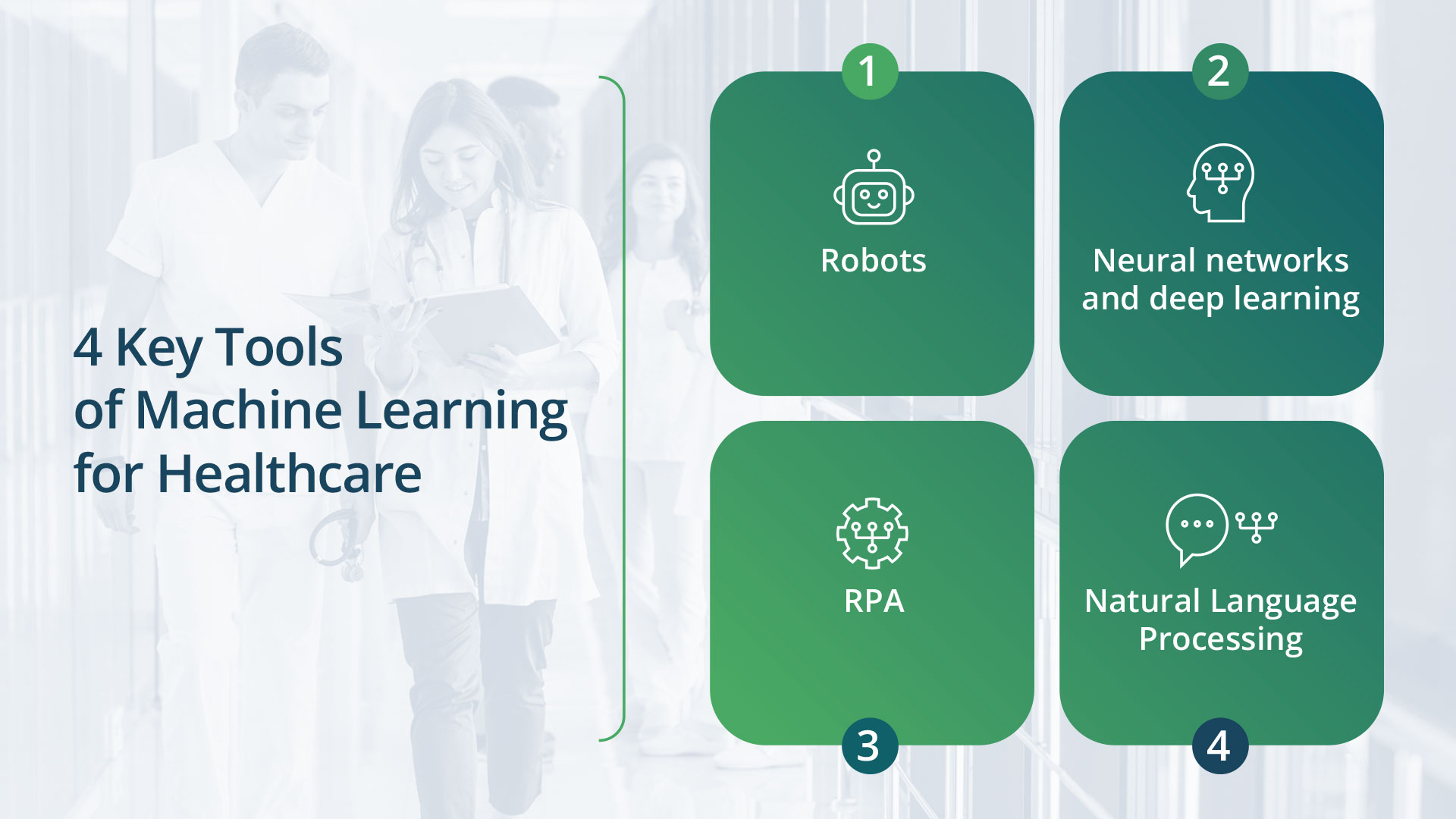
Robots
Physical robots are the first thing that may come to one’s mind while discussing the role of artificial intelligence in daily human operations. Though it may sound alarming, physical robots are becoming the best friends of medical workers when it comes to complex surgeries and other medical procedures requiring extreme accuracy of movements.Neural networks and deep learning
Neural networks mimic the neural network structure of our brain. Thus, in healthcare, artificial neural networks can imitate the mental process of a human while making a diagnosis. The logic of ANN is built around deep learning, i.e., the capabilities of artificial neural networks to learn from a massive amount of data.RPA
Robotic Process Automation (RPA) is a technology based on the capabilities of a machine to imitate human behavior while performing mundane, routine tasks. Automating such tasks as data entry, transfer, and categorization, significantly reduces the time of medical workers for more value-added tasks.NLP
Natural Language Processing deals with the capability of machines to perceive, analyze and generate human language. In healthcare, this feature can be applied to extracting and analyzing patient data from a doctor’s notes or dedicated medical software.4 reasons to use ML in healthcare
It is hard to imagine the healthcare industry moving at such a fast pace without the technological advances that it is actively leveraging. Artificial intelligence and machine learning are one of major drivers of this industry. And here are four reasons why.-
Improved medical diagnosis
-
Cost reduction
- verification of patients’ insurance for an automated financial clearance process
- ongoing detection of an additional patient coverage
- various kinds of notifications, such as patient status changes
- checking of a patient’s medical records and billing information accuracy
- 24/7 claim statuses check
-
Enhanced care
-
Innovations
- making predictions on the perspective tablet path during the coating
- analyzing the time spent by tablets under the spray zone
- studying the segregation of powders
- analyzing varying blade shapes and speed
Wrapping Up
We’ve observed four main reasons machine learning is at the forefront of the AI movement in the healthcare industry and provided a brief overview of 4 relevant use cases of this technology. The worldwide practice of embracing intelligent solutions when it comes to human lives instead of perceiving technological breakthroughs as something distant and dangerous has already played its role in the rapidly evolving healthcare environment. Kanda has 17 years of experience working with healthcare organizations. Being a go-to development partner for enterprises, mid-sized companies, and innovative eHealth startups, we combine expertise in health-related technologies with in-depth domain knowledge and a deep background in cybersecurity, HIPAA-compliant development, EMR, Medical Analytics, Reporting, and mHealth. We’ve always looked beyond the hype of AI and Machine Learning and strived to translate these technological advancements into quantifiable and customized solutions to customers’ problems. Talk to our experts today and learn how machine learning can transform your healthcare operations.Related Articles
CMS Prior Authorization Rule 2026: What Health Systems and Payers Actually Need to Build by October 2027
Key Takeaways The 2026 CMS Prior Authorization (CMS-0062-P) rule extends electronic prior authorization requirements to drugs for the first time, closing a major gap left by the 2024 rule. The hard compliance deadline is October 1, 2027 - by that date, systems must be live, not in development or testing. Compliance requires three major technical…Learn More
Unlocking Actionable Insights from Medical Data with Clinical NLP
Key Takeaways Clinical NLP extracts useful details from notes, reports, and other free-text records so teams can work with them. The clearest use cases include coding support, trial matching, safety monitoring, registry work, and population health. The output is only useful if it connects to the standards healthcare teams already use: SNOMED CT, RxNorm, LOINC,…Learn More
Why Omics and Clinical Data Integration Remain a Challenge and How to Fix It
Key Takeaways Omics and clinical data often remain separate, making them harder to use together than they should be. The main challenge is usually not the data itself, but the mismatched formats, siloed systems, and disconnected teams surrounding it Addressing that requires robust infrastructure, shared standards, and workflows that hold up without constant manual intervention.…Learn More
AI Copilots in Healthcare: Minimizing Diagnostic Risks With Smart Virtual Assistants
Key Takeaways AI copilots act as always-on virtual assistants managing documentation, triage, and decision support so clinicians can focus on patients. With 12 million diagnostic errors and up to 80,000 deaths annually, AI copilots are built to catch what overloaded clinicians miss, not replace them. Dragon Copilot saves clinicians around 5 minutes per encounter with…Learn More